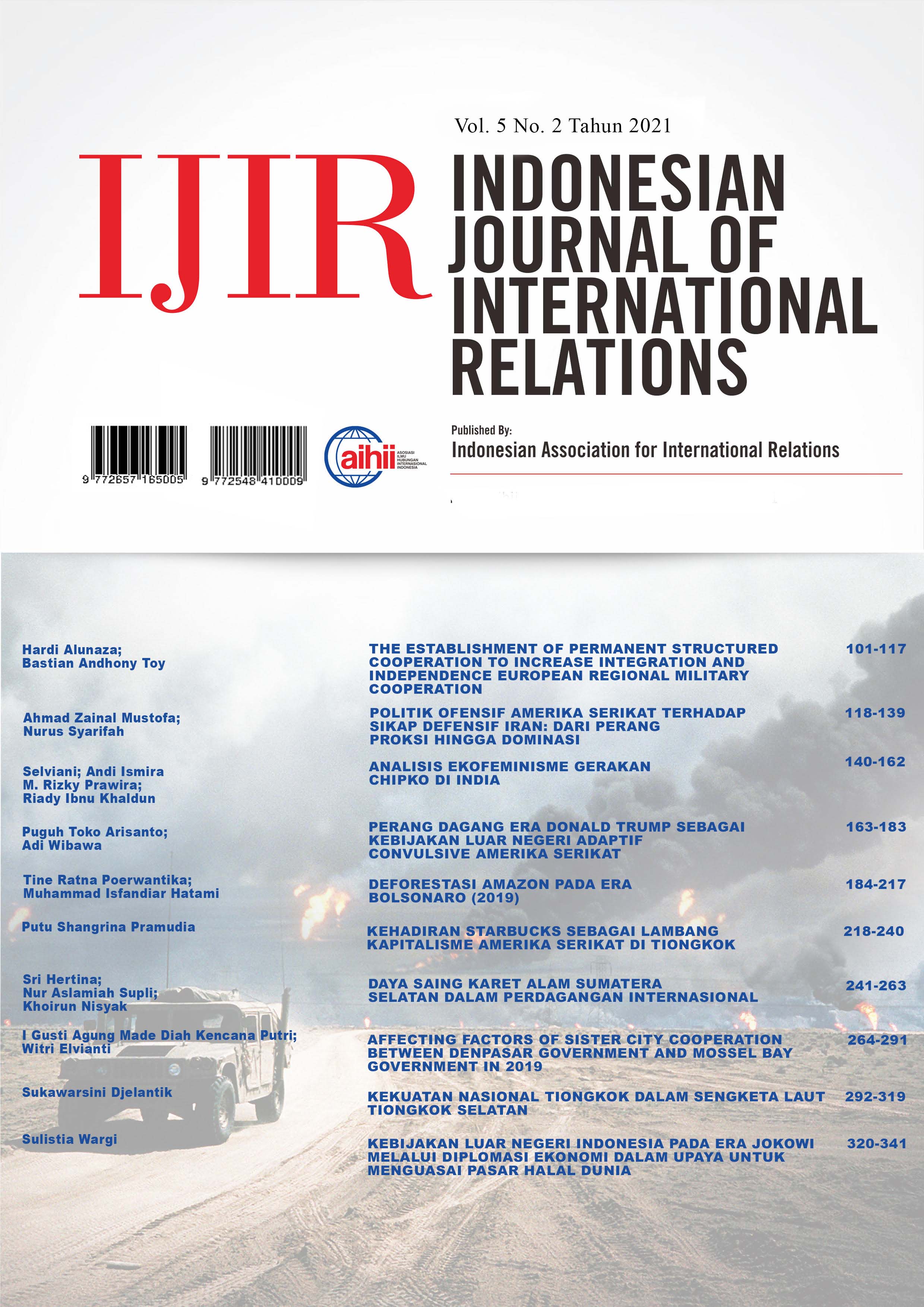
THE ESTABLISHMENT OF PERMANENT STRUCTURED COOPERATION TO INCREASE INTEGRATION AND INDEPENDENCE EUROPEAN REGIONAL MILITARY COOPERATION
DOI:
https://doi.org/10.32787/ijir.v5i2.193Keywords:
Integration, Security, Defense, PESCO, European Union.Abstract
This paper aims to discuss the efforts of the European Union in enhancing integration and defense-security cooperation through the establishment of Permanent Structured Cooperation. This paper seeks to answer how the formation of PESCO can increase the integration and independence of military cooperation between EU member states. Whereas before there has been a North Atlantic Treaty Organization as a security pillar that has long been recognized in the European region. The author uses the theory of regional security complex and the concept of collective security in analyzing related phenomena. This research uses descriptive method with qualitative approach. The data collection technique is literature study consisting of books, journals, and including data from reliable websites to support the explanation of this paper. The results of this research indicate the establishment of PESCO as a form of implementation of Article 42 paragraph 6 of the Lisbon Treaty in 2009 concerning the efforts of member countries in establishing defense-security cooperation within the European Union framework. The establishment of the PESCO was also based on doubts by the European Union on the role of the US in NATO, but PESCO did not directly replace NATO but rather as a complement to autonomous and effective crisis resolution.
Downloads
References
Aydın-Düzgit, S., & Marrone, A. (2018). PESCO and Security Cooperation Between the EU and Turkey. http://www.iai.it/en/node/8508.
Biscop, S. (2018). European defence: Give PESCO a chance. Survival, 60(3), 161–180. https://doi.org/10.1080/00396338.2018.1470771
Damarjati, D. (2018). Mulai Berani ke AS, Paris-Berlin Kukuh di Pakta Pertahanan Uni Eropa. https://news.detik.com/internasional/d-3871297/mulai-berani-ke-as-paris-berlin-kukuh-di-pakta-pertahanan-uni-eropa
DW (Deutsche Welle). (2017). PESCO: EU army one step closer after defense pact agreement. https://www.dw.com/en/pesco-eu-army-one-step-closer-after-defense-pact-agreement/a-41741828
European Defence Agency. (2018). Permanent Structured Cooperation (PESCO). https://www.eda.europa.eu/what-we-do/our-current-priorities/permanent-structured-cooperation-(PESCO)
European Parliament. (2018). DRAFT REPORT on annual report on the implementation of the Common Security and Defence Policy.
European Union External Action (EEAS). (2018). Permanent Structured Cooperation. https://eeas.europa.eu/headquarters/headquarters-Homepage/34226/permanent-structured-cooperation-pesco-factsheet_en
Irwan, M. N. S. B. (2017). Transformasi Kebijakan NATO (North Atlantic Treaty Organization) Dalam Penanganan Ancaman Non-tradisional (Studi Kasus: The 2010 New Strategic Concept). Universitas Hasanuddin.
Nurdiana, N. A. (2019). Peran Politik Keamanan Rusia di Kawasan Asia. EJournal Ilmu Hubungan Internasional, 7(1), 153–166. www.international.sindonews.com/read/1053624/40/rusia-ancang-ancang-
Parliament.uk. (2018). EU Defence: the realisation of Permanent Structured Cooperation (PESCO).
Raco, J. R. (2010). Metode Penelitian Kualitatif - Jenis, Karakteristik, dan Keunggulannya. Jakarta: PT. Gramedia Widiasarana Indonesia.
Somek, A. (2007). Kelsen Lives. European Journal of International Law, 18(3), 409–451. https://doi.org/10.1093/ejil/chm028
Sugiyono. (2010). Memahami Penelitian Kualitatif. Bandung: Alfabeta.
Ulusoy, H. (2003). Possible Transformation of Collective Security Arrangements in the Post-September 11 Era. http://turkishpolicy.com/article/36/possible-transformations-of-collective-security-arrangements-in-the-post-september-11-era-spring-2003
VOA Indonesia. (2017). Trump Terus Kecam Anggota NATO karena Sumbangan yang Tak Memadai. https://www.voaindonesia.com/a/trump-terus-kecam-anggota-nato-karena-sumbangan-yang-tak-memadai/4476289.html
Yakti, P. D. (2016). Kebutuhan Uni Eropa Terhadap Institusi Keamanan : Peranan NATO di Era Kontemporer. Jurnal Hubungan Internasional, 1, 81–98.
Downloads
Published
Issue
Section
License
The Indonesian Journal of International Relations (IJIR) is licensed under a Creative Commons Attribution-ShareAlike 4.0 International License

Copyright Notice
An author who publishes in the Indonesian Journal of International Relations (IJIR) agrees to the following terms:
- The author retains the copyright and grants the journal the right of first publication of the work simultaneously licensed under the Creative Commons Attribution-ShareAlike 4.0 License, which allows others to share the work with an acknowledgment of the work's authorship and initial publication in this journal
- Author is able to enter into separate, additional contractual arrangements for the non-exclusive distribution of the journal's published version of the work (e.g., post it to an institutional repository or publish it in a book) with the acknowledgment of its initial publication in this journal.
- The author is permitted and encouraged to post his/her work online (e.g., in institutional repositories or on their website) prior to and during the submission process, as it can lead to productive exchanges as well as earlier and greater citation of the published work (see The Effect of Open Access).
Read more about the Creative Commons Attribution-ShareAlike 4.0 License here: https://creativecommons.org/licenses/by-sa/4.0/.
Privacy Statement
The names and email addresses entered in this journal site will be used exclusively for the stated purposes of this journal and will not be made available for any other purpose or to any other party.
How to Cite